St Luke's Anglican Church

2a Tees Street and Itchen Street, OAMARU

Historic Place Category 1

List No. 4365

Quick links:
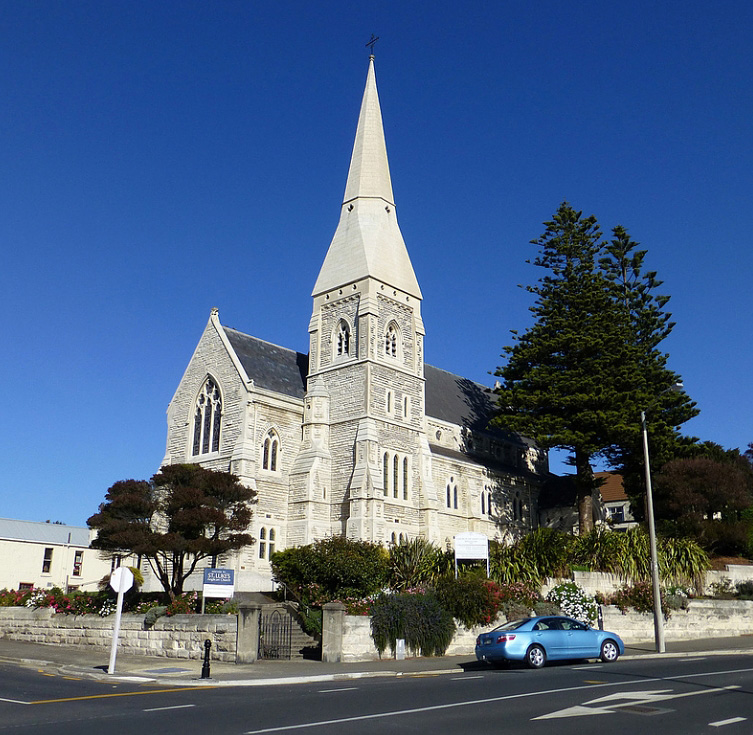
Built in stages between 1865 and 1913, St Luke’s Anglican Church was designed by Dunedin architects Edward Rumsay and Adam Jackson in Gothic style and has architectural, historical and spiritual significance as an outstanding landmark in Oamaru. It has been the spiritual home for the parish for over 150 years.

Anglican services were held in Oamaru from the early 1860s, in a variety of makeshift venues such as the Oamaru goods shed, the Greta Street school and the courthouse. Oamaru became a parish in 1864. In July 1862, the Reverend Algernon Gifford was licensed to the township and pastoral district of Oamaru, and the parish set to work raising funds for a church. Dunedin architects Edward Rumsey and Adam Jackson won the competition to design the church, with William Armson as supervising architect, and James Bruce as the contractor. Right Reverend Lord Bishop of Christchurch laid the foundation stone and dedicated the cornerstone on 20 June 1865. The first service was held on 29 October, but the church was not consecrated until 13 May 1866. The southern end of the nave was built first with double walls of Oamaru stone, dressed inside and imitation ashlar outside, and three feet thick at the base. By 1871 the church was too small for the congregation.

In 1876 the full length of the nave to the region of the spire was completed with temporary wooden chancel. The extension doubled the size of the church, and was now the length on the original plans, with Forrester and Lemon supervising the building. Barclay and Kay were the stone masons, while West and Sinclair were the carpenters. A Conacher pipe organ was installed in the side chapel.

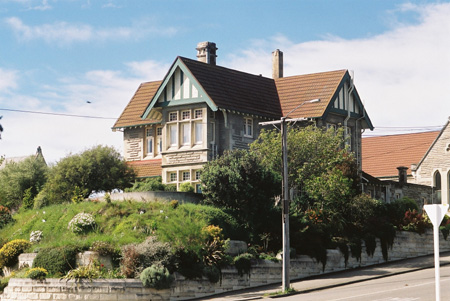
In 1897 a Sunday School was opened next to the church, designed by J.M. Forrester. In 1909, the vicarage was built on the corner section of Wharfe and Tees Streets (List Entry No. 4884).

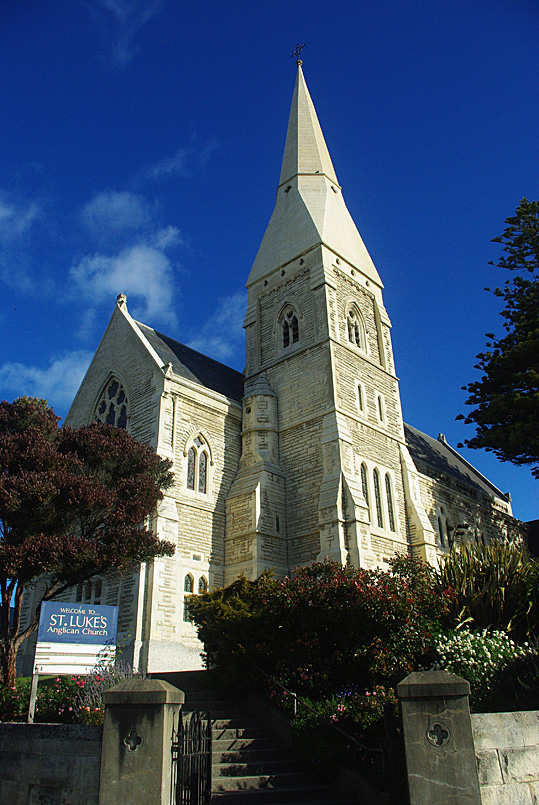
Though there was discussion and some fund raising for the spire and stone chancel in the 1880s, it was not until 1913 that these were completed. Bequests and fund raising enabled the church to be completed to the original plan. The Oamaru Mail provides a full description of the finished church. Bishop Neville laid the corner stone on 27 June 1912. J.M. Forrester supervised the constriction, while McKenzie and Mills were the stone masons. The woodwork was completed by D. Sinclair. This stage completed the chancel and the spire. The church grounds were further developed by the erection of the stone wall at Tees Street, including an iron gate with concrete pillars and steps. The spire is 127 feet high and topped with a stone cross. There are also stone crosses on the gable ends of the nave. Much of the woodwork in the chancel is in Southland beech, and much of the wood carving in the church is the work of F G Gurnsey, an English trained church carver.

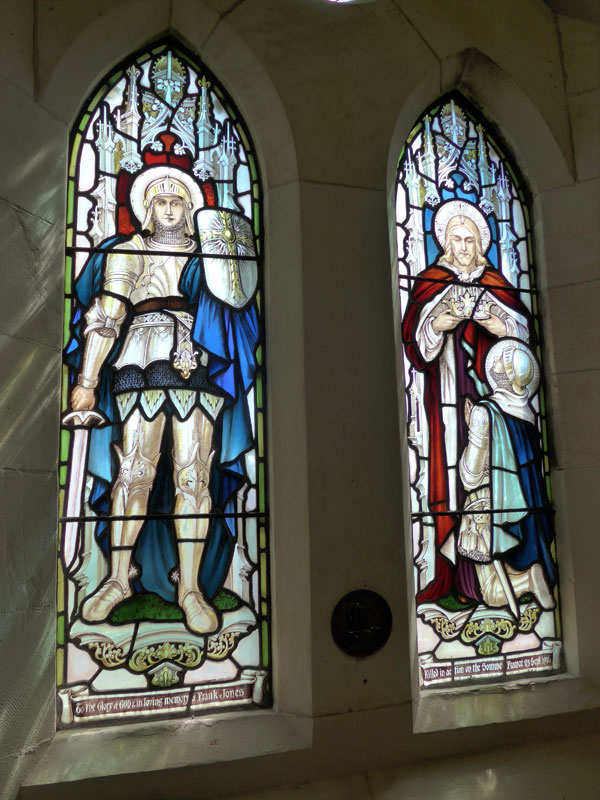
Other notable features include the World War One Memorial, already in the planning stages in October 1919. The ‘Fallen Soldiers’ Memorial’ was dedicated on 17 October 1920. The memorial ‘comprises a stained glass window depicting the images of a soldier, St Luke and Jesus; and three panels made from glazed tiles in cast iron and timber frames. Two record the names of congregation members who lost their lives serving overseas. On the opposite wall, a wooden tablet lists the names of soldiers who returned.’ St Luke’s has several memorial windows, dating from after 1900 to 1986, that are significant features of the church.

In 2009 the parish restored the church, repairing and restoring stone work, stained glass, and installing a sprinkler system, new carpet and lighting in the interior. In 2015, St Luke’s remains the place of worship for its parishioners.
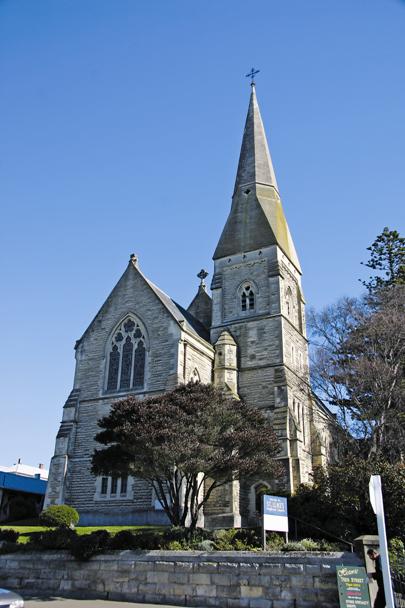
St Luke's Anglican Church, Oamaru | A Breese | 25/01/2024 | Heritage New Zealand Pouhere Taonga
St Luke's Anglican Church, Oamaru. Image courtesy of www.flickr.com | Madam48 - Shelley Morris | 19/04/2011 | Shelley Morris
St Luke's Anglican Church, Oamaru | Bill Caelli | 01/06/2012 | Bill Caelli
St Luke's Anglican Church, Oamaru. Stained Glass c.2014 CC BY-NC 3.0 Image courtesy of nzhistory.govt.nz | Brue Ringer | © Crown Copyright

List Entry Information

Overview

Status

Listed

List Entry Status

Historic Place Category 1

Access

Private/No Public Access

List Number

4365

Date Entered

26th November 1987

Date of Effect

26th November 1987

City/District Council

Waitaki District

Region

Otago Region

Extent of List Entry

Extent includes the land described as Secs 13-14 Blk XXVI Town of Oamaru (RT OT231/57), Otago Land District, and the building known as St Luke’s Anglican Church thereon.

Legal description

Secs 13-14 Blk XXVI Town of Oamaru (RT OT231/57), Otago Land District

Status

Listed

List Entry Status

Historic Place Category 1

Access

Private/No Public Access

List Number

4365

Date Entered

26th November 1987

Date of Effect

26th November 1987

City/District Council

Waitaki District

Region

Otago Region

Extent of List Entry

Extent includes the land described as Secs 13-14 Blk XXVI Town of Oamaru (RT OT231/57), Otago Land District, and the building known as St Luke’s Anglican Church thereon.

Legal description

Secs 13-14 Blk XXVI Town of Oamaru (RT OT231/57), Otago Land District

Significance

Why is this place significant?

Historic Significance

Historical Significance or Value This is the major Anglican church of North Otago. The first Anglican church services in Oamaru were held either on a grassy knoll near the present railway goods shed or in various woolstores, the Greta St Grammar School or the Courthouse. A Parsonage was built first out of town in 1862 (Oamaru was surveyed off in 1860), and the Rubble Fund started for a church in the same year. Bishop Selwyn gave 200 pounds to buy suitable sections for the churches and halls. The site for St Lukes was bought for 50 pounds in a position close to the old industrial centre and landing place. The first store, built by Charles Trail, of cabbage tree stems plastered inside and out had been set up on land alongside the church section. The church was built in sections as the money became available.

Physical Significance

ARCHITECTURAL SIGNIFICANCE: One of the largest gothic churches in Otago. TOWNSCAPE/LANDMARK SIGNIFICANCE: A major building at the east end of Oamaru's main street and well related to the other fine Oamaru stone buildings in this part of the town.

Why is this place significant?

Historic Significance

Historical Significance or Value This is the major Anglican church of North Otago. The first Anglican church services in Oamaru were held either on a grassy knoll near the present railway goods shed or in various woolstores, the Greta St Grammar School or the Courthouse. A Parsonage was built first out of town in 1862 (Oamaru was surveyed off in 1860), and the Rubble Fund started for a church in the same year. Bishop Selwyn gave 200 pounds to buy suitable sections for the churches and halls. The site for St Lukes was bought for 50 pounds in a position close to the old industrial centre and landing place. The first store, built by Charles Trail, of cabbage tree stems plastered inside and out had been set up on land alongside the church section. The church was built in sections as the money became available.

Physical Significance

ARCHITECTURAL SIGNIFICANCE: One of the largest gothic churches in Otago. TOWNSCAPE/LANDMARK SIGNIFICANCE: A major building at the east end of Oamaru's main street and well related to the other fine Oamaru stone buildings in this part of the town.

Construction Information

Construction Professional

Name

Kay and Barclay

Type

Stonemason

Biography

No biography is currently available for this construction professional

Name

D. Sinclair

Type

Builder

Biography

No biography is currently available for this construction professional

Name

Ramsey and Jackson

Type

Architectural Partnership

Biography

Architects for the upper end of the nave of St Luke's Anglican Church.

Name

Forrester & Lemon

Type

Architectural Partnership

Biography

The architectural partnership of Forrester and Lemon was established in Oamaru in 1872. Thomas Forrester (1838-1907) was born in Glasgow and educated at the Glasgow School of Art. Emigrating to New Zealand in 1861 he settled in Dunedin and worked under William Mason (1810-97) and William Henry Clayton (1823-77) and later Robert Arthur Lawson (1833-1902). In 1865 he superintended the Dunedin Exhibition and from 1870 he became involved with the supervision of harbour works. Some time after 1885 he became Engineer to the Oamaru Harbour Board and in this capacity designed the repairs to the breakwater following storm damage in 1886 and later the Holmes Wharf. On his death in 1907 he was still in the employ of the Harbour Board. John Lemon (1828-1890) was born in Jamaica and travelled to England before emigrating to New Zealand in 1849. He settled in Oamaru in 1860 and with his brother Charles established a timber merchant's business. By 1869 he was in partnership with his father-in-law, George Sumpter calling themselves "Timber and General Merchants, Land and Commission Agents". This partnership was dissolved in 1872 and Lemon entered into partnership with Forrester. Lemon had no architectural experience at all, but had a wide circle of business contacts and was an efficient administrator. Buildings designed by the partnership of Forrester and Lemon include St Paul's Church (1875-76), the Harbour Board Offices (1876), Queen's (later Brydone) Hotel (1881), Waitaki Boys' High School (1883), The Courthouse (1883) and the Post Office (1883-84), all in Oamaru. Forrester and Lemon contributed greatly to Oamaru's nineteenth century character. On Lemon's death in 1890 the practice was taken over by Forrester's son, John Megget Forrester (1865-1965).

Name

James Bruce

Type

Builder

Biography

No biography is currently available for this construction professional

Name

West and Sinclair

Type

Builder

Biography

No biography is currently available for this construction professional

Name

McKenzie and Mills

Type

Stonemason

Biography

No biography is currently available for this construction professional

Construction Details

Start Year

1901

startYearCirca

Type

Additional building added to site

Description

Stone wall on Itchen Street laid

Start Year

1920

Type

Addition

Description

World War One Memorial dedicated

Start Year

2009

Type

Restoration

Description

Restoration and repair

Start Year

1865

Finish Year

1866

Type

Original Construction

Description

First part of construction

Start Year

1875

Finish Year

1876

Type

Addition

Description

Second part of construction - Nave completed to full length. Temporary wooden chancel built

Start Year

1913

Type

Addition

Description

Completion of the spire and chancel, stone walls around boundary extended

Start Year

1922

Type

Addition

Description

West porch was added.

Construction Materials

Materials are Oamaru stone for the walls and slate for the roof of the nave. The southern end of the nave was built first with double walls of Oamaru stone, dressed inside and imitation ashlar outside, and three feet thick at the base. Though this section was consecrated in 1866, by 1871 the church was too small for the congregation. In 1876 the full length of the nave to the region of the spire was completed with temporary wooden chancel built on the end. Though there was discussion and some fund raising for the spire and stone chancel in the 1880s, it was not until 1913 that these were completed. The spire is 127 feet high and topped with a stone cross. There are also stone crosses on the gable ends of the nave. Much of the woodwork in the chancel is in Southland beech, and much of the wood carving in the church is the work of F G Gurnsey, an English trained church carver.

Notable Features

The tall spire at the end of Oamaru's main street.

Construction Professional

Name

Kay and Barclay

Type

Stonemason

Biography

No biography is currently available for this construction professional

Name

D. Sinclair

Type

Builder

Biography

No biography is currently available for this construction professional

Name

Ramsey and Jackson

Type

Architectural Partnership

Biography

Architects for the upper end of the nave of St Luke's Anglican Church.

Name

Forrester & Lemon

Type

Architectural Partnership

Biography

The architectural partnership of Forrester and Lemon was established in Oamaru in 1872. Thomas Forrester (1838-1907) was born in Glasgow and educated at the Glasgow School of Art. Emigrating to New Zealand in 1861 he settled in Dunedin and worked under William Mason (1810-97) and William Henry Clayton (1823-77) and later Robert Arthur Lawson (1833-1902). In 1865 he superintended the Dunedin Exhibition and from 1870 he became involved with the supervision of harbour works. Some time after 1885 he became Engineer to the Oamaru Harbour Board and in this capacity designed the repairs to the breakwater following storm damage in 1886 and later the Holmes Wharf. On his death in 1907 he was still in the employ of the Harbour Board. John Lemon (1828-1890) was born in Jamaica and travelled to England before emigrating to New Zealand in 1849. He settled in Oamaru in 1860 and with his brother Charles established a timber merchant's business. By 1869 he was in partnership with his father-in-law, George Sumpter calling themselves "Timber and General Merchants, Land and Commission Agents". This partnership was dissolved in 1872 and Lemon entered into partnership with Forrester. Lemon had no architectural experience at all, but had a wide circle of business contacts and was an efficient administrator. Buildings designed by the partnership of Forrester and Lemon include St Paul's Church (1875-76), the Harbour Board Offices (1876), Queen's (later Brydone) Hotel (1881), Waitaki Boys' High School (1883), The Courthouse (1883) and the Post Office (1883-84), all in Oamaru. Forrester and Lemon contributed greatly to Oamaru's nineteenth century character. On Lemon's death in 1890 the practice was taken over by Forrester's son, John Megget Forrester (1865-1965).

Name

James Bruce

Type

Builder

Biography

No biography is currently available for this construction professional

Name

West and Sinclair

Type

Builder

Biography

No biography is currently available for this construction professional

Name

McKenzie and Mills

Type

Stonemason

Biography

No biography is currently available for this construction professional

Construction Details

Start Year

1901

startYearCirca

Type

Additional building added to site

Description

Stone wall on Itchen Street laid

Start Year

1920

Type

Addition

Description

World War One Memorial dedicated

Start Year

2009

Type

Restoration

Description

Restoration and repair

Start Year

1865

Finish Year

1866

Type

Original Construction

Description

First part of construction

Start Year

1875

Finish Year

1876

Type

Addition

Description

Second part of construction - Nave completed to full length. Temporary wooden chancel built

Start Year

1913

Type

Addition

Description

Completion of the spire and chancel, stone walls around boundary extended

Start Year

1922

Type

Addition

Description

West porch was added.

Construction Materials

Materials are Oamaru stone for the walls and slate for the roof of the nave. The southern end of the nave was built first with double walls of Oamaru stone, dressed inside and imitation ashlar outside, and three feet thick at the base. Though this section was consecrated in 1866, by 1871 the church was too small for the congregation. In 1876 the full length of the nave to the region of the spire was completed with temporary wooden chancel built on the end. Though there was discussion and some fund raising for the spire and stone chancel in the 1880s, it was not until 1913 that these were completed. The spire is 127 feet high and topped with a stone cross. There are also stone crosses on the gable ends of the nave. Much of the woodwork in the chancel is in Southland beech, and much of the wood carving in the church is the work of F G Gurnsey, an English trained church carver.

Notable Features

The tall spire at the end of Oamaru's main street.

Physical Description

ARCHITECTURAL DESCRIPTION (Style) Style is Victorian Gothic. MODIFICATIONS: The exterior is unmodified.

ARCHITECTURAL DESCRIPTION (Style) Style is Victorian Gothic. MODIFICATIONS: The exterior is unmodified.

Reference

Historical and Associated Iwi / Hapū / Whānau

Completion Date

11th August 2015

Report Written By

Heather Bauchop

Information Sources

Evans, 1968

J. Evans 1968 Southern See: The Anglican Diocese of Dunedin New Zealand, J. McIndoe, Dunedin

Oamaru Mail

22 Mar 1882, p. 2.

Naylor, 1962

W. Naylor, Anglican centenary : a narrative covering 100 years of the Church of England in North Otago, Oamaru, 1962, Oamaru Mail Company

Other Information

This historic place was registered under the Historic Places Act 1980. This report includes the text from the original Building Classification Committee report considered by the NZHPT Board at the time of registration. Please note that entry on the New Zealand Heritage List/Rarangi Korero identifies only the heritage values of the property concerned, and should not be construed as advice on the state of the property, or as a comment of its soundness or safety, including in regard to earthquake risk, safety in the event of fire, or insanitary conditions. A fully referenced upgrade report is available on request from the Otago/Southland Office of Heritage New Zealand

Historical and Associated Iwi / Hapū / Whānau

Completion Date

11th August 2015

Report Written By

Heather Bauchop

Information Sources

Evans, 1968

J. Evans 1968 Southern See: The Anglican Diocese of Dunedin New Zealand, J. McIndoe, Dunedin

Oamaru Mail

22 Mar 1882, p. 2.

Naylor, 1962

W. Naylor, Anglican centenary : a narrative covering 100 years of the Church of England in North Otago, Oamaru, 1962, Oamaru Mail Company

Other Information

This historic place was registered under the Historic Places Act 1980. This report includes the text from the original Building Classification Committee report considered by the NZHPT Board at the time of registration. Please note that entry on the New Zealand Heritage List/Rarangi Korero identifies only the heritage values of the property concerned, and should not be construed as advice on the state of the property, or as a comment of its soundness or safety, including in regard to earthquake risk, safety in the event of fire, or insanitary conditions. A fully referenced upgrade report is available on request from the Otago/Southland Office of Heritage New Zealand

Further Information

Current Usages

Uses: Religion

Specific Usage: Church

Former Usages

General Usage: Religion

Specific Usage: Church

Themes

War Memorial

Current Usages

Uses: Religion

Specific Usage: Church

Former Usages

General Usage: Religion

Specific Usage: Church

Themes

War Memorial

Stay up to date with Heritage this month